|
|
Weekly Chasidic Story #1360 (5784-17) 20 Tevet 5784 (Jan.
1 2024)
"Naming a Mother and Daughter"
At the time I was holding that fax, I felt as if I was literally holding ruach
hakodesh [Divine inspiration] in my hands.
Connection: The name in Hebrew of the 2nd book of the Torah, which we started
studying this week, and the name of its first weekly reading, is Shemot, which
in English means "NAMES."
Story in PDF
format for more convenient printing
NAMING A MOTHER AND A DAUGHTER
THE FIRST STORY I [Rabbi Moshe-Dovid Gutnick] am about to relate took
place in 1987. I had just moved to Bondi, Australia, to become the rabbi of
the Mizrachi Synagogue, when one of the congregants came to speak with me about
choosing a Hebrew name for herself. For whatever reason her parents hadn't given
her a Hebrew name at the time of her birth. Instead, they named her Leonie,
after her grandfather who was called Leo and whose Hebrew name was Aryeh Leib.
She really wanted to take the name Ariella, which made sense to her since Aryeh,
her grandfather's name, is Hebrew for lion, and Leo or Leonie is Latin for lion,
and Ariella is feminine derivative of Aryeh. But she had a very conservative
mindset and, to her, the name Ariella was too modern and seemed not traditional
enough. She felt she should choose Rachel or Leah or something like that.
I told her, "Judaism teaches that, when our parents give us names, they
are blessed with Ruach HaKodesh, Divine Inspiration. Now I don't have
ruach hakodesh, so I can't advise you. But the Rebbe does. If you'd like, I
will write to him and ask his opinion on this issue."
She agreed. Not only that - she wrote the letter to the Rebbe herself. In this
letter she explained how she was named by her parents and why. What she didn't
say was that her personal preference was to be named Ariella.
When I read the letter, I asked her, "Why didn't you write that you are
drawn to the name Ariella? The Rebbe will be interested to know that this is
the name you would really want for yourself."
But she said she couldn't bring herself to write that. She reasoned that this
name was too modern, and the Rebbe wouldn't be pleased with such a choice. Now
it's true that in those days Ariella might have been viewed as an unusual name
for a religious woman, though it's not so anymore.
I faxed her letter to New York and, within twenty-four hours, we had the Rebbe's
response through his secretary, Rabbi Leibel Groner:
"The name Ariella is quite common now."
In other words, the Rebbe picked the name that she preferred and allayed her
concerns at the same time.
Of course she was thrilled and amazed to no end (as was I) that the Rebbe chose
the name that she, in her heart of hearts, really wanted - and so very grateful
that he had the foresight to address her concerns at the same time.
* * *
THE SECOND STORY that I would like to relate also concerns choosing a name
for a woman, this time a new mother. This happened a couple of years later -
in 1989. A friend of mine, Rabbi Pinchas Woolstone, who was at that time Director
of the Jewish House in Sydney, came to me with a problem concerning a family
that I did not know. The mother of this family had given birth to a son and,
in order to name the baby at the circumcision, she needed a Hebrew name. That
is, the baby's name is announced at the bris as X, the son of Y, and both X
and Y need to be Hebrew names. For reasons of Jewish law, the father's name
could not be used in this case.
Now, a Hebrew name for a girl or woman is given at the time of a Torah reading.
The next one which was to take place was on Thursday, with the bris scheduled
for the following day. The day that Pinchas came to me with this issue was Sunday.
I responded to him in the same way I did to Leonie - that is, let's write to
the Rebbe.
This we did and, as before, we sent the letter by fax on that Sunday. Monday
came and went, but there was no answer. Tuesday came and went, but again there
was no answer. Wednesday the same thing. Thursday was the day the woman's father
was going to have an aliyah during the Torah reading, at which time he was to
give a Hebrew name to his daughter. So, they had no choice - they had to pick
the name themselves.
The woman's name was Jennifer and everyone thought that an appropriate Hebrew
equivalent would be Judith - that is Yehudis (or Yehudit). However, she decided
that she wanted the name Bracha. The name Bracha had nothing in common with
the name Jennifer, but she was determined that this should be her name despite
everyone's objections. And that is the name she was given.
On that Thursday morning, I came from my synagogue to the Jewish House. It was
about fifteen minutes after the end of prayers and a fax had arrived while services
were in progress. Pinchas was standing there holding the fax, repeating over
and over: "I don't believe it … I don't believe it … I don't
believe it."
"Pinchas, what don't you believe?" I asked. He didn't answer, so I
walked over to him and took the fax out of his hands. When I read it, I started
repeating, "I don't believe it … I don't believe it." The secretary
who was sitting there was puzzled, "What's going on rabbis? What don't
you believe?" The fax was from the Rebbe's office and it said:
"In relation to Jennifer, I suggest the name Bracha. And I want to add
that each individual is entitled to choose a name for himself or herself."
So the Rebbe suggested the name Bracha for her, which is the name that she herself
had chosen, and by implication also reproved those who objected to her choice.
Two times this happened - the Rebbe had picked a name that the person had also
wanted, and he gave an explanation on each occasion that pointedly addressed
the situation at hand.
I clearly recall that at the time I was holding that fax I felt as if I was
literally holding ruach hakodesh in my hands. It is a moment I will never forget.
~~~~~~~~~~~~~~~~~~~~~~~
Source: Lightly edited and supplemented by Yerachmiel Tilles from a weekly email
of "Here's My Story," a part of JEM's extraordinary "My Encounter
with the Rebbe" project. [Photo courtesy of Jwire.com.au.]
Connection: The name in Hebrew of the 2nd book of the Torah, which we started
studying this week, and the name of its first weekly reading, is Shemot,
which in English means "NAMES."
Biographic notes:
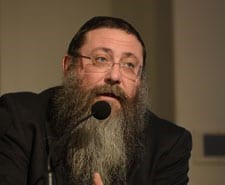 Rabbi
Moshe-Dovid Gutnick is one of the heads of the Rabbinical Court in Sydney
and the head of the NSW Kashrut Authority. He is also the current President
of the Rabbinical Council of Australia and New Zealand. He has been a Chabad
emissary in Sydney since 1982, where he was interviewed in July of 2016. Rabbi
Moshe-Dovid Gutnick is one of the heads of the Rabbinical Court in Sydney
and the head of the NSW Kashrut Authority. He is also the current President
of the Rabbinical Council of Australia and New Zealand. He has been a Chabad
emissary in Sydney since 1982, where he was interviewed in July of 2016.
Rabbi Menachem Mendel Schneerson, the Lubavitcher Rebbe
(11 Nissan 1902 - 3 Tammuz 1994), became the seventh Rebbe of the Chabad dynasty
after his father-in-law, Rabbi Yosef Yitzchak Schneersohn, passed away in Brooklyn
on 10 Shvat 1950. He is widely acknowledged as the greatest Jewish leader of
the second half of the 20th century. Although a dominant scholar in both the
revealed and hidden aspects of Torah and fluent in many languages and scientific
subjects, the Rebbe is best known for his extraordinary love and concern for
every Jew on the planet. His emissaries around the globe dedicated to strengthening
Judaism number in the thousands. Many hundreds of volumes of his teachings have
been printed, and hundreds of English renditions too.
 Yerachmiel
Tilles is co-founder and associate director of Ascent-of-Safed, and chief editor
of this website (and of KabbalaOnline.org). He has hundreds of published stories
to his credit, and many have been translated into other languages. He tells
them live at Ascent nearly every Saturday night. Yerachmiel
Tilles is co-founder and associate director of Ascent-of-Safed, and chief editor
of this website (and of KabbalaOnline.org). He has hundreds of published stories
to his credit, and many have been translated into other languages. He tells
them live at Ascent nearly every Saturday night.
To receive the Story by e-mail every Wednesday--sign
up here!
"Festivals of the
Full Moon"
("Under the Full Moon" vol 2 - holiday stories)
is now available
for purchase from ASCENT
* ~ * ~ * ~ * ~ *
Book 1 of Yerachmiel Tilles's 3-volume set,
"Saturday Night, Full Moon",
is also available for purchase on
our KabbalaOnline-shop
site.
back to Top back
to this year's Story Index Stories
home page Stories Archives
|
