From The Masters Of Kabbalah and Chumash (5 Books of
Moses)
13th century - "RambaN" - Rabbi Moshe ben
Nachman
14th century - "Bachya" - Rabbi Bachya ben
Asher
16th century - "Alsheich" - Rabbi Moshe
Alshech of Tsfat
17th century - "Shelah" - Rabbi Yeshaiya
Horowitz
18th century - "Ohr HaChayim" - Rabbi Chaim
Ben Attar
Ramban
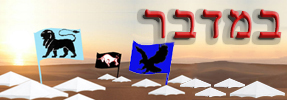
"Every man shall encamp by his own standard, with the sign of
their fathers house." [2:2]
"Each standard was to have a colored cloth hanging in it, the color
of one being unlike the color of another. The color of each standard corresponded
to that of the stone fixed in the breastplate [of the High Priest, on
which the name of that scribe was engraved], and by this method everyone
would recognize his standard." This is Rashi's language.
But Rabbi Abraham ibn Ezra commented: "There were signs on each of
the [four main] standards. Thus the ancients sages said that on Reuben's
standard there was a figure of a man decorated with mandrakes, and on
Judah's standard there was the form of a lion, to which Jacob had compared
him, and on Ephraim's standard was the figure of an ox, based upon [the
expression that Moses used in speaking of that tribe], the firstborn of
his ox, and on Dan's standard was the figure of an eagle. Thus [the four
signs on the four main standards] were similar to the four figures that
the prophet Ezekeil saw [in the Divine Charriot]." The Tent of Meeting
was in the exact center, with the camps of the Levites surrounding it
in the midst of the camps [of the other tribes], as is mentioned in Sefer
Yitzirah: "And the Holy Temple is placed exactly in the middle."
I have furthermore seen in the Midrash [the following text]: "And
just as the Holy One, blessed be He, created four directions in the universe,
so He surrounded His Throne with four 'living creatures', and high above
them all is the Throne of Glory. The Holy One, blessed be He, told Moses
to arrange the standards in a manner corresponding to these directions.
There [in Bamidbar Rabba] the Rabbis also interpret [the division of the
tribes of Israel] according to four standards as corresponding to the
four groups of angels [surrounding the celestial Throne]. The Midrash
also explains there that [the division of the tribes was not arbitrary
but] it was all in wisdom, [showing] honor and greatness to Israel, and
that therefore Scripture mentions everything in detail.
(credits)
Rabbeinu Bachya
"..each man by his flag according to the insignia."
[2:2]
A kabbalistic approach: the Israelites wished for flags similar to those
of the angels. The division of the Israelites' camp into four sections
comprising three tribes each facing each direction on earth reflected
a similar phenomenon in the celstial regions. The four celestial camps
are known as the camps of the Shechinah - Divine Presence (Midrash Maasseh
Merkavah chapter 6). The tribes of the Israelites in addition had twelve
maps. Each one differently colored and easily identifiable one from the
other. This too reflected what they had observed when the angels had come
to earth when these "maps" were in the form of fiery flames
each differently colored.
(credits)
Alsheich
"Nadav and Avihu died before G-d when they offered unauthorized
fire to G-d in the Sinai desert. They had no sons. Thus only Eleazar and
Itamar served as priests.." [3:4]
Q) Why were the younger brothers appointed as priests only after the
older brothers had died?
A) Nadav and Avihu had been anointed already during the lifetime of their
father, and even been allowed to perform service in the tabernacle. Their
generally fine conduct had protected them against retribution by G-d until
the fateful day when they introduced "strange fire" into the
tabernacle. Another reason that Eleazar and Ittamar were made priests
is, that neither Nadav nor Avihu left behind them sons who could have
taken their fathers' place, especially if such sons had already been born
at the time of their fathers' having received their appointment. Had they
left behind sons, they would have taken over from their father regardless
of when they had been born.
This idea is confirmed in the Zohar, which explains that Pinchas had
not lost any privilege by having been born before his father had been
appointed to the priesthood. He would have been in line for the priesthood
anyway. The only reason the Torah had to state that he and his descendants
would be priests was that he had killed a person (to halt immorality and
stop a plague), something which normally disqualified a priest from performing
temple service. According to the view that Pinchas had not become a priest
previously because he had been born before his father had been anointed,
the meaning of our verse "they had no sons", would be that they
had not sired any sons since they had been anointed, since anointment
conferred priesthood status only on themselves and future issue. The appointment
of Pinchas enabled the departed souls of Nadav and Avihu to be absorbed
by the latter, whose priesthood became the continuation of Nadav and Avihu.
(credits)
Shelah
"Take the sum of all the congregation of the children of Israel,.."
(1:2)
As a rule, nothing counted or measured attracts blessing. This rule applies,
however, only when the numbering or measurement is intrinsically physical,
meaning part of this material world. Such numbers do not bode well, since
by their very definition, they stress individuality and separateness,
each item being counted separately.
A number also suggests limitation. Even if we say, "The number of
the children of Israel will be as the sands of the beaches of the sea"
(Gen. 22:17), an apparent blessing, the presumption still is that ultimately,
this is a limitation, since the number is finite.
However, in the context of the spiritual world, a number does not imply
limitation. On the contrary, once something is numbered it will have an
infinite existence, usually on an ascending level; an object that is numbered
advances towards ever-greater achievements.
This is why the prophet predicts of the Jewish people, "The number
of the people of Israel will be like the sand of the sea that can be neither
measured nor counted" (Hosea 2:1). We understand this verse as pointing
out the difference between numbering something in this world, and that
of numbering something in the World to Come. In the World to Come, numbering
does not entail finitude. This is true even though the enumeration does
take place, as is evident from the words "cannot be counted",
which suggest that somebody is indeed attempting to count.
The message, though, is that the count cannot be completed - it cannot
be finalized. This is also what the Rabbis may have meant when they said
that the Hebrew word "to count", "mispar",
refers to a time when Israel performs the will of G-d, while "cannot
be counted", in Hebrew "lo yisofer", refers to a
time when Israel fails to do so (Yoma 22). When Israel does not perform
the will of G-d, their cleaving to this physical material world is the
reason. When they do perform the will of their Maker, however, even their
enumeration does not constitute something finite, something that imposes
limitations on their development. Then it is not something negative. On
the contrary, the counting is very beneficial.
Ohr HaChayim
"The Levites will belong to Me I am the Lord." [3:45]
The reason the Torah added the words "I am the Lord," is to
tell us that although according to Yalkut Shimoni 364 there will come
a time when the firstborn will once again be performing the priestly functions
in the Holy Temple, the Levites will not therefore be demoted and cease
to belong to G-d. The very expression "will belong to Me" indicates
that just as G-d's name is eternal, so is the appointment of the Levites
to their task.
(credits)
Sources
Ramban
- credits
Adapted from the 13th century classic by the illustrious scholar, philosopher
and defender of the faith, Rabbi Moshe ben Nachman-known as 'RAMBAN' or
'Nachmanides', a master kabbalist in his own right and a major link in
the transmission of Jewish mysticism-based on the excellent annotated
English translation, Nachmanides on the Torah, by Rabbi Dr. Charles B.
Chavel
Bachya
- credits
Selected with permission from the seven-volume English edition of The
Torah Commentary of Rabbeinu Bachya, as translated and annotated by Eliyahu
Munk. Rabbi Bachya ben Asher [1255-1340] of Saragosa, Spain, was the outstanding
pupil of Rabbi Shlomo ben Aderet (the "Rashba"), a main disciple
of Rabbi Moshe ben Nachman (the "Ramban"). Several books have
been written about the Kabballah-based portions of R. Bachya's commentary.
Alsheich
- credits
Adapted from Torat Moshe - the 16th commentary of Rabbi Moshe Alshech,
the "Preacher of Zefat" on the Torah, as translated and condensed
in the English version of Eliyahu Munk)
Shelah
- credits
Rabbi Isaiah Horowitz was born in Prague around the year 1565. He served
as Rabbi of Cracow and other congregations before he was appointed as
the Rabbi of the community of Frankfurt on Main in the year 1610. In 1916,
Rabbi Horowitz moved to Prague where he became the Chief Rabbi of the
city. He moved to Eretz Yisrael about 1621. He was rabbi in Jerusalem
and in Tiberias, where he died in or about 1630. In addition to his magnus
opus, Shenei Luchot HaBrit, he also compiled an edition of the prayer-book
with a comprehensive commentary. Many of his innovations, including his
formulation of the Kol Nidrei prayer, have become part and parcel of the
Ashkenazi Siddur.
Ohr HaChayim
- credits
Selected with permission from the five-volume English edition of Ohr HaChaim:
the Torah Commentary of Rabbi Chaim Ben Attar, as translated and annotated
by Eliyahu Munk.
The holy Rabbi Chayim ben Moses Attar was born in Sale, Western Morocco,
on the Atlantic in 1696. His immortal commentary on the Five Books Of
Moses, Or Hachayim, was printed in Venice in 1741, while the author was
on his way to the Holy Land. He acquired a reputation as a miracle worker,
hence his title "the holy," although some apply this title only
to his Torah commentary.
|